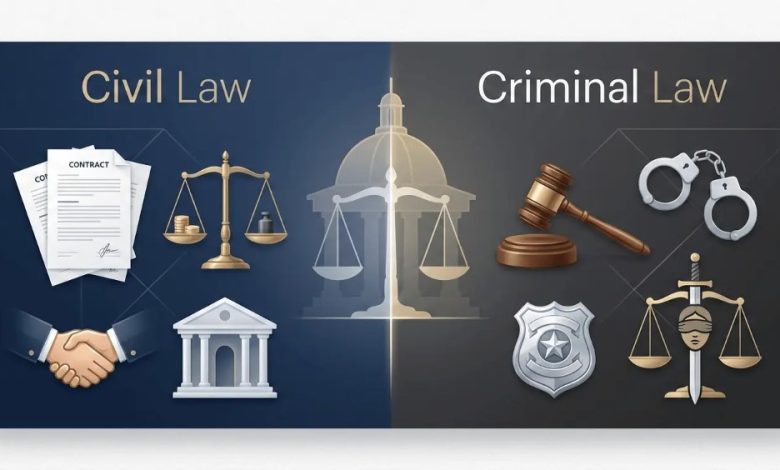
Understanding the difference between criminal vs civil law is essential for anyone interested in how legal systems work. Although both branches of law help maintain order and resolve disputes, they serve different purposes and follow distinct procedures. Criminal law focuses on offenses against society or the state, while civil law deals with disputes between individuals, organizations, or entities.
In today’s world, legal disputes are becoming increasingly complex. From cybercrime and financial fraud to contract disagreements and personal injury claims, both criminal and civil laws play critical roles in protecting rights and ensuring justice. Knowing how these legal systems operate can help individuals better understand their responsibilities and legal protections.
The debate surrounding criminal vs civil law often arises because some actions can lead to both criminal prosecution and civil lawsuits. For example, a person accused of assault may face criminal charges from the government and a separate civil claim for damages from the victim. This overlap makes it important to understand the unique characteristics of each legal framework.
What Is Criminal Law?
Criminal law is a body of law that addresses conduct considered harmful to society as a whole. When a person commits an act classified as a crime, the government prosecutes the offender on behalf of the public. The primary objective is to punish wrongdoing, deter future crimes, and maintain public safety.
Criminal offenses can range from minor violations, such as traffic offenses, to serious crimes like murder, robbery, terrorism, cybercrime, and large-scale fraud. In criminal cases, prosecutors must prove beyond a reasonable doubt that the accused committed the alleged offense. This high standard of proof exists because criminal convictions can result in severe penalties, including imprisonment, fines, probation, or other restrictions on liberty.
Modern criminal law has evolved significantly to address emerging challenges. Digital crimes, identity theft, online scams, and cyberattacks have become major concerns worldwide. Governments continuously update criminal statutes to respond to technological advancements and protect citizens from new forms of criminal behavior.
What Is Civil Law?
Civil law focuses on resolving disputes between private parties rather than punishing criminal conduct. These disputes may involve individuals, businesses, organizations, or government entities acting in a non-criminal capacity. The primary purpose of civil law is to compensate injured parties and restore them, as much as possible, to their original position.
Common civil cases include contract disputes, property disagreements, family law matters, employment conflicts, consumer protection claims, and personal injury lawsuits. Instead of seeking punishment, the plaintiff generally seeks financial compensation, specific performance of a contract, or another form of legal remedy.
The burden of proof in civil cases is typically lower than in criminal proceedings. Courts generally decide civil disputes based on a “preponderance of the evidence” or a similar standard, meaning that one party’s version of events is more likely true than not. This distinction represents one of the most significant differences in the discussion of criminal vs civil law.

Criminal vs Civil Law: Core Differences
While both legal systems aim to uphold justice, they differ in purpose, procedure, and outcomes. Understanding these differences helps clarify how courts handle various legal matters.
Comparison Table: Criminal vs Civil Law
| Aspect | Criminal Law | Civil Law |
|---|---|---|
| Purpose | Punish offenders and protect society | Resolve disputes and compensate victims |
| Parties Involved | Government vs accused person | Individual or organization vs another party |
| Burden of Proof | Beyond a reasonable doubt | Preponderance of evidence |
| Outcome | Conviction or acquittal | Judgment for plaintiff or defendant |
| Penalties | Prison, fines, probation, community service | Monetary damages, injunctions, specific performance |
| Who Files the Case? | Government prosecutor | Private individual or entity |
| Main Goal | Public safety and deterrence | Compensation and dispute resolution |
This comparison highlights why criminal vs civil law remains one of the most fundamental distinctions within any legal system.
Purpose and Objectives of Criminal and Civil Law
The objectives of criminal law extend beyond individual victims. Criminal statutes are designed to protect society by discouraging harmful behavior and holding offenders accountable. When the state prosecutes a criminal case, it acts on behalf of the public interest rather than a single individual.
Civil law, on the other hand, primarily addresses private rights and obligations. The goal is not necessarily to punish but to resolve disagreements and provide remedies for losses suffered by individuals or organizations. For example, if a business breaches a contract, the injured party may seek compensation through civil litigation rather than criminal prosecution.
These differing objectives illustrate why courts treat criminal vs civil law cases differently. One system emphasizes societal protection, while the other focuses on individual rights and remedies.
Burden of Proof: Why It Matters
One of the most important distinctions in criminal vs civil law is the burden of proof. Criminal cases require prosecutors to establish guilt beyond a reasonable doubt. This rigorous standard protects individuals from wrongful convictions and reflects the serious consequences of criminal punishment.
Civil cases generally require proof by a preponderance of the evidence. This means the plaintiff must show that their claim is more likely true than false. Because civil judgments typically involve financial compensation rather than imprisonment, the legal system allows a lower evidentiary threshold.
The difference in proof standards can sometimes lead to situations where a defendant is acquitted in criminal court but found liable in civil court. Such outcomes demonstrate how the two legal systems operate independently despite addressing related facts.
Common Examples of Criminal Cases
Criminal law covers a wide range of offenses that threaten public safety, security, or welfare. These offenses vary in severity and legal consequences.
Some common criminal cases include:
- Theft, burglary, and robbery
- Assault, domestic violence, and homicide
- Drug trafficking and possession offenses
- Cybercrime, identity theft, and online fraud
- Financial crimes such as money laundering and embezzlement
In each of these situations, government authorities investigate the allegations and determine whether criminal charges should be filed. The focus remains on protecting society and enforcing the law.
Common Examples of Civil Cases
Civil disputes arise in everyday life and affect individuals and businesses alike. These cases often involve disagreements over rights, obligations, or compensation.
Examples of civil cases include:
- Breach of contract disputes
- Property ownership disagreements
- Personal injury and negligence claims
- Employment and workplace disputes
- Consumer protection and product liability cases
Unlike criminal prosecutions, these cases are initiated by private parties seeking legal remedies. Understanding such examples helps clarify the practical application of criminal vs civil law in daily life.
Can One Act Lead to Both Criminal and Civil Cases?
Yes, a single incident can result in both criminal and civil proceedings. This occurs because the same conduct may violate public laws while also causing harm to an individual.
Consider a drunk-driving accident. The government may prosecute the driver under criminal law for violating traffic and public safety regulations. At the same time, injured victims may file civil lawsuits seeking compensation for medical expenses, lost income, and emotional suffering.
Similarly, fraud cases often involve criminal prosecution for deceptive conduct and civil actions seeking financial recovery. These dual proceedings demonstrate how criminal and civil courts address different aspects of the same event.
The Role of Technology in Modern Legal Systems
Technology has transformed both criminal and civil law in recent years. Courts increasingly rely on digital evidence, electronic records, surveillance footage, and online communications when evaluating cases. Cybersecurity concerns have also led to the expansion of laws addressing hacking, data breaches, and digital fraud.
Artificial intelligence, blockchain technology, and electronic discovery tools are reshaping legal investigations and litigation processes. While these innovations improve efficiency, they also raise questions about privacy, evidence authentication, and legal accountability.
The evolution of technology continues to influence discussions surrounding criminal vs civil law, particularly as lawmakers work to regulate emerging digital environments and protect citizens’ rights.
How Courts Handle Criminal and Civil Cases
Criminal and civil courts follow different procedural rules. Criminal proceedings generally involve investigations by law enforcement agencies, formal charges by prosecutors, and trials that may include juries. Defendants are entitled to various constitutional protections because their liberty may be at risk.
Civil proceedings begin when a plaintiff files a complaint against a defendant. The parties exchange evidence through discovery, negotiate settlements when possible, and proceed to trial if necessary. Many civil disputes are resolved through mediation or arbitration before reaching a courtroom.
Although procedures vary by jurisdiction, the distinction between criminal vs civil law remains consistent across most legal systems worldwide.
Why Understanding the Difference Matters
Knowledge of legal systems empowers individuals to make informed decisions and protect their rights. Whether dealing with a business contract, workplace issue, accident claim, or criminal accusation, understanding the appropriate legal framework can significantly affect outcomes.
Businesses also benefit from recognizing the differences between criminal and civil liability. Corporate misconduct may trigger regulatory investigations, criminal penalties, and civil lawsuits simultaneously. Effective compliance programs help organizations reduce legal risks and maintain public trust.
As legal issues become more interconnected in modern society, awareness of criminal vs civil law becomes increasingly valuable for citizens, professionals, and business leaders alike.
FAQs
What is the main difference between criminal vs civil law?
The primary difference is that criminal law addresses offenses against society and seeks punishment, while civil law resolves disputes between private parties and focuses on compensation or other remedies.
Who brings a criminal case to court?
A criminal case is typically brought by the government through prosecutors who represent the interests of society. Victims may participate as witnesses, but the state controls the prosecution.
Can a person be involved in both a criminal and civil case for the same incident?
Yes. A single event may result in criminal charges and civil claims. For example, an assault may lead to criminal prosecution and a civil lawsuit seeking damages.
Which requires a higher burden of proof?
Criminal law requires proof beyond a reasonable doubt, which is a significantly higher standard than the preponderance of evidence generally used in civil cases.
Are financial penalties possible in criminal cases?
Yes. Criminal courts may impose fines in addition to imprisonment, probation, or other sanctions. However, these penalties serve a punitive purpose rather than compensating victims directly.
Why is understanding criminal vs civil law important?
Understanding criminal vs civil law helps individuals recognize their legal rights, responsibilities, and available remedies when facing legal disputes or allegations.
Conclusion
The distinction between criminal vs civil law forms the foundation of modern legal systems. Criminal law seeks to protect society by prosecuting and punishing offenders, while civil law focuses on resolving disputes and compensating those who have suffered losses. Although the two systems sometimes overlap, they serve different purposes, follow different procedures, and produce different outcomes.
As society continues to evolve through technological innovation, globalization, and changing legal challenges, both criminal and civil law remain essential tools for maintaining justice and accountability. By understanding the differences between these legal frameworks, individuals can better navigate legal issues, safeguard their rights, and make informed decisions when disputes arise.
Read More:-Law and Order Criminal Intent: Crime Drama Explained